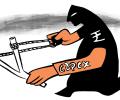
Capital expenditure by 54 large central public sector enterprises and five departmental arms, having a capex minimum target of Rs 100 crore, rose 93 per cent year-on-year (YoY) in the April-May period to Rs 1.39 trillion. The National Highways Authority of India (NHAI) and the Railways have started this financial year's capex cycle on a stronger note. In the first two months of FY24, the 54 CPSEs, along with the departmental arms, achieved 19 per cent of their combined budget target of Rs 7.33 trillion, Business Standard has learnt.

The Supreme Court on Monday in-principle agreed to reconsider its earlier judgement on Hindustan Petroleum Corporation Ltd and Bharat Petroleum Corporation Ltd divestment, and stayed proceedings before all high courts concerning divestment.
Divestment Minister Arun Shourie will meet Law Minister Arun Jaitly in New Delhi on Thursday to consider options before the government and chalk out future strategy.
Angry Congress, Samajwadi Party and Left party members on Thursday stalled Question Hour in Lok Sabha for about 15 minutes.
Government has begun drawing contingency plans to avert any shortage of domestic cooking gas as a result of go-slow agitation by employees of the country's largest oil company Indian Oil Corp.
No divestment of oil PSUs during during the month-long recess of the current Budget session of Parliament beginning March 14, Parliamentary Affairs Minister Sushma Swaraj categorically assured Lok Sabha on Thursday.\n\n
The government on Wednesday ruled out privatisation of Indian Oil, Oil and Natural Gas Corporation and Gas Authority of India Ltd and assured all security concerns would be taken care of while divesting public sector oil
Kicking off the divestment process in the two public sector oil companies, Hindustan Petroleum Corporation and Bharat Petroleum Corporation, the government

With the new owner shelling out Rs 18,000 crore for the buyout of 'Maharaja' this would be the highest ever amount garnered through privatisation or even the cumulative sum garnered through strategic sale in 1999-00 to 2003-04. The government had garnered roughly over Rs 5,000 crore during that five-year period by privatising 10 CPSEs.
Petroleum ministry strongly supported the proposal of 26 per cent government holding in Hindustan Petroleum Corporation in the post disinvestment era to prevent new management from stripping or re-selling of company's assets to third party.\n\n
The Cabinet Committee on Divestment failed to take any decision on the divestment of public sector oil companies -- Hindustan Petroleum Corporation and Bharat Petroleum Corporation.
Faulty laws helped oil majors IOC, HPCL and BPCL -- to avoid excise payment of Rs 713 crore (Rs 7.13 billion) to the government during April-December 2002, the Comptroller and Auditor General of India has said.
The government has put a spanner in the plans of oil companies like Reliance Industries Limited and Hindustan Petroleum Corporation Limited to make ethanol directly from sugarcane, without producing sugar.
The companies that have signed these pacts with the India chapter of the Berlin-based Transparency International include PSU majors such as GAIL (India), Coal India, Oil and Natural Gas Corporation, Steel, Hindustan Petroleum Corporation, Steel Authority of India, National Mineral Development Corporation and Rashtriya Ispat Nigam. In fact, 12 of the 14 companies that signed the pact, did so in the last six months.
The government is understood to have deferred 'indefinitely' the financial bidding for Shipping Corporation of India and Hindustan Copper Ltd in the wake of a spate of petitions challenging the divestment process in various courts.\n\n\n\n
The divestment ministry would concentrate on "legal option" to resolve the divestment impasse arising out of the Supreme Court verdict on HPCL and BPCL, but would continue with residual stake sale plans in companies like CMC Ltd and VSNL.
Global oil major British Petroleum and French oil giant Total are eyeing equity in Hindustan Petroleum Corp's Rs 8,336 crore
The state-run Hindustan Petroleum Corporation Ltd has proposed to lay a Rs 1,300 crore (Rs 13 billion) pipeline from Mundra in Gujarat to Delhi for transporting petroleum products to northern India.
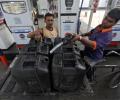
The cut reflects changes in global prices of the two fuels since the last revision.
Hindustan Petroleum Corporation Ltd will invest over Rs 900 crore (Rs 9 billion) on expansion and modernisation of its retail network in 2006-07, Petroleum Minister Murli Deora said on Tuesday.

The government on Thursday permitted 100 per cent foreign investment under the automatic route in oil and gas PSUs which have received in-principle approval for strategic divestment. The move would facilitate privatisation of India's second biggest oil refiner Bharat Petroleum Corp Ltd (BPCL). The government is privatising BPCL and selling its entire 52.98 per cent stake in the company.
Divestment Minister Arun Shourie said on Tuesday that his ministry had furnished all the facts to Attorney General for getting his opinion on the legal aspects of privatising public sector oil company, Hindustan Petroleum Corporation.
A day ahead of a crucial meeting of the Cabinet Committee on Divestment, Defence Minister George Fernandes said he favoured public sector units like Oil and Natural Gas Corporation to be allowed to bid for HPCL.
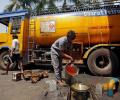
Investors shunned shares of oil marketing companies (OMCs) on Friday as they feared that the government's decision to cut retail prices of petrol and diesel could hurt the companies' profit margins in the near term. On Thursday, the government announced that OMCs will reduce pump prices of petrol and diesel after a record 22 months, making them cheaper by Rs 2 per litre in the national capital. The changes were effective from Friday.
Petroleum Minister Ram Naik said on Wednesday that he would forward to the Cabinet Committee on Divestment the proposals from public sector units under his ministry to bid for Hindustan Petroleum Corporation Ltd after examining individual proposals.
Hindustan Petroleum Corporation Limited, India's second largest public sector oil company has signed up fast bowler Zaheer Khan to endorse its lube brands.\n\n

Petrol and diesel prices were cut by Rs 2 per litre each as state-owned oil companies ended a nearly two-year-long hiatus in rate revision, just hours before the general election schedule was announced.
Indian Oil Corporation has been ranked as the number one oil trading company amongst national oil companies in the Asia Pacific region.\n
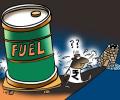
In all, petrol price has gone up by Rs 1.74 per litre and diesel by Rs 1.78 a litre in three days.
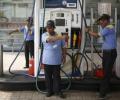
State-owned fuel retailers are losing close to Rs 3 per litre on selling diesel while the profit on petrol has trimmed due to recent firming up in international oil prices, industry officials said detailing reasons for continuing to hold retail prices. Indian Oil Corporation (IOC), Bharat Petroleum Corporation Ltd (BPCL) and Hindustan Petroleum Corporation Ltd (HPCL), who control roughly 90 per cent of India's fuel market, 'voluntarily' have not changed petrol, diesel and cooking gas (LPG) prices for almost two years now, resulting in losses when input cost was higher and profits when raw material prices were lower.
